


There is a moment many Java developers experience today. After years spent building reliable systems, modernizing monoliths, shaping APIs, orchestrating containers, and keeping distributed applications alive, someone suddenly asks whether you can “add a bit of AI.” At first it sounds innocent. You try a model endpoint, run a quick experiment in Quarkus, watch a few responses appear in your terminal, and feel the spark of possibility. It looks easy. Almost too easy.
Then reality arrives, quietly at first and then all at once. More teams hear about your small prototype and want their own version. A colleague suggests plugging AI into customer support. Someone else wants to classify documents. Another team wants predictive insights for scheduling. And the CIO wants an innovation roadmap on their desk by next week. Very quickly, your calm workspace starts to resemble the bar of a crowded pub on a Friday evening. Everyone wants a drink, nobody knows how it should be mixed, half of the ingredients are missing, and most requests contradict each other.
That is the situation many developers wake up in today. AI is inspiring and powerful, yet without the right foundation, it can create pressure and confusion faster than any technology wave before it. To understand how to avoid this, it helps to look at AI the way a bartender looks at customers. Different customers want different things. They behave differently, they need different ingredients, and the bartender must understand those differences before attempting to serve them.
The Three Friends at the Bar: Understanding AI Architectures
Imagine three friends walking into your bar. Each of them represents the kind of AI system we see in the real world.

The first friend knows absolutely nothing but can find almost anything. Ask him what is good and he will search reviews, old blog posts, recommendations from friends and whatever the internet has to offer. He pieces everything together until he has something that resembles an informed answer. This friend represents retrieval augmented generation. The model itself does not contain your domain knowledge. Your application performs the search, retrieves relevant documents from internal systems or vector embeddings, and the model turns that context into an answer. This approach is ideal for companies whose knowledge changes frequently or where accuracy and traceability matter. In a Java world this fits naturally inside a Quarkus service that orchestrates searches across databases or APIs. You can even log which documents were used for each answer. When your compliance team asks how a conclusion was produced, you can simply show them the context that was provided.
The second friend always orders the same drink. Not similar, not almost the same, but exactly the same. He does not read the menu, does not experiment and does not change his routine. This is a fine tuned model. You take a base model and adapt it to your domain through training. The result is extremely comfortable when your context is narrow and stable. Think of invoice classification, fraud detection or routing rules for banking documents. The model becomes fast and predictable. But when your data evolves, the model must evolve as well. Suddenly you are retraining, validating, comparing versions and reviewing behaviour. Fine tuning (e.g., through InstructLab) is wonderful for the right use case but painful when the business shifts every few weeks.
The third friend behaves very differently. Before you even sit down, she has already spoken to the bartender, checked whether the kitchen is open, verified whether you can move to a quieter table, asked for sparkling water, and possibly ordered a small appetizer because she guessed you might be hungry. This friend stands for agentic AI systems. The model becomes part of an orchestrated workflow. It calls APIs, interacts with rules engines, reads schedules, books meetings and manipulates data. It can be extremely powerful in a Java environment where you combine the model’s reasoning with Camel routes or Kafka events. It can also spiral into unpredictable behaviour if left uncontrolled, which is why these systems require strong guardrails, monitoring and domain rules.
These three characters are more than metaphors. They offer a way to think about AI architectures without falling in love with one approach. The question is never which one is the cleverest. The question is which one matches your use case, your data, your regulatory environment and your ability to maintain it for years.
Why AI Projects Stumble: The World Around the Model
Teams often get excited by the model and forget the rest. A model is interesting, sometimes even impressive, but it never lives alone. Real systems live inside a web of data sources, service boundaries, network dependencies, approvals, security controls and architectural constraints. This is where many initiatives begin to crack.
Consider what happens when a Java application sends customer data to a model running externally. You need answers to very practical questions. Should the prompts be stored or deleted. Is the provider allowed to retrain on your content. Are you crossing jurisdictions by accident. How do you guarantee that personally identifiable information is not leaking (even with enterprise contracts). And how do you explain behaviour to your auditors when the model suddenly begins to make unexpected decisions. Most teams only discover these questions once the first incident occurs.
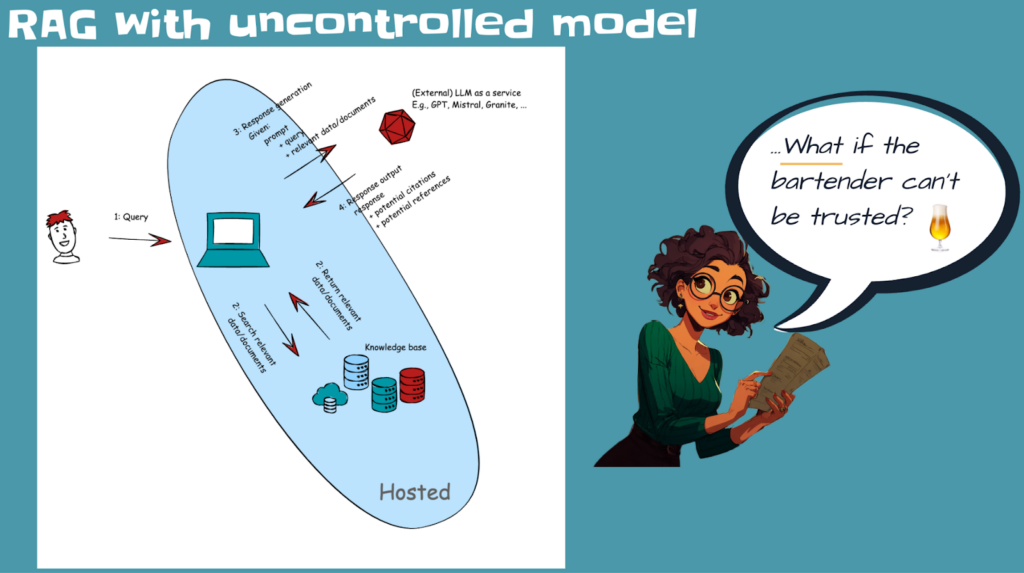
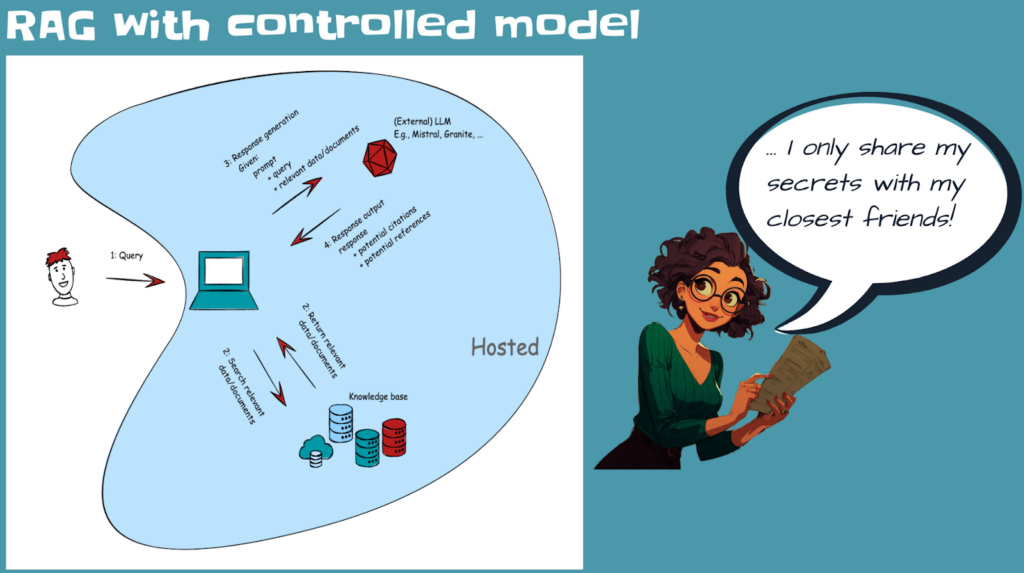
Even simple questions like authentication become complex. Your model endpoint needs identity. The embedding service needs entitlements. Your storage needs controls. Your observers need logs. And once you add asynchronous behaviour or streaming, the number of moving parts grows quickly. The problem was never the model. It was everything around it.
Nothing Works Without Data: The Bartender Needs Orders
Before mixing a drink, a bartender needs a clear order. If they receive five different orders from five different people at five different times, the bar descends into chaos. AI behaves no differently. If your data is inconsistent, stale or delivered too late, the model produces unpredictable results.
This is where structured data flows become critical. Event pipelines, change data capture, carefully designed schemas and stable contracts help ensure that everything the model sees is fresh and coherent. A bank that wants AI to generate customer overviews cannot use slightly outdated records. A hospital cannot summarise patient histories based on twenty minute old information. A logistics company cannot classify incoming orders if half of the information arrives through delayed batch processes. Java systems connected through Kafka or Debezium pipelines solve precisely this problem by ensuring the AI layer behaves like a calm bartender receiving clean, real time orders rather than chasing people around the bar.
When the data flows correctly, AI becomes stable. When the data is chaotic, even the best model becomes unreliable.
An AI System Needs a Well Run Bar: Platform Engineering
As soon as an AI system becomes more than a prototype, developers discover that the real challenge is not building the model based feature. The real challenge is running it. You suddenly need versioning, rollbacks, automated deployments, secure model storage, test environments, resource limits and consistent infrastructure. You need metrics showing how often prompts fail. You need traces that show how long inference took. You need logs that reveal what the model saw. You need policies that restrict which services can send what information to which model. These are areas where e.g., service meshes can bring added value.
Without a platform these responsibilities scatter across teams who reinvent solutions constantly. With a platform you create golden paths that handle these concerns for every team. Developer portals guide users through template driven creation of AI services. GitOps ensures everything is declarative and observable. Service meshes enforce security and routing without manual configuration. Observability stacks reveal behaviour and drift. Suddenly the bar is not chaotic at all. It becomes a calm, predictable environment where even complex cocktails can be served repeatedly without surprises.
This discipline is not glamorous, yet it determines whether AI becomes a sustainable capability or an experiment that collapses under real world pressure.
Where Should the Model Live: The Importance of Optionality
Every organisation eventually confronts a crucial question. Should the model run locally, inside containers managed by something like Podman or Kubernetes. Should it run as a fully self hosted deployment on OpenShift AI. Or should it rely on hosted APIs in the cloud.
The correct answer changes over time. Local models offer privacy and full control. Hosted models offer convenience and rapid experimentation. Hybrid models blend both. The mistake is committing too early. The landscape of AI frameworks, model families and licensing shifts constantly. What seems affordable now may become costly. What seems accurate now may become outdated. What seems legally safe today may be regulated tomorrow.
A sound Java architecture treats the location of the model as an implementation detail rather than a foundation. Quarkus applications that speak through clean abstraction layers can swap out endpoints without a system wide rewrite. That flexibility is a form of long term resilience. It ensures the bar remains open even when suppliers change their catalogues.
The Real Secret: It Is Not About the Drink, It Is About the Bar
When you watch a professional bartender on a busy night, you notice that the magic is rarely in the individual drink. It is in the rhythm. The organisation. The clean tools. The quiet coordination. The confidence that nothing will fall apart when more people walk in.
Enterprise AI is exactly the same. Anyone can mix a quick demo. But serving hundreds of customers consistently is something else entirely. It requires an architecture that respects data, protects privacy, manages complexity, enforces boundaries and provides clarity for every developer involved.
This is where Java developers have a unique advantage. Our ecosystem has always been about reliability, clarity, modularity and strong engineering discipline. When those traditions meet the creative potential of AI, we gain systems that are not only clever but also stable.
The future will belong to the teams that run their AI systems the way experienced bartenders run their bars. Calmly. Predictably. Responsibly. And with room to adapt when new ingredients arrive.
Anyone can pour a drink once.
Not everyone can keep serving when the rush hits.
The teams who understand this distinction will be the ones who turn AI from a trend into a capability that lasts.

This article is part of the JAVAPRO magazine issue:
Engineering Intelligence - Building Systems in the AI Age
Explore what engineering means in the AI age — beyond code generation and automation.
Gain insights into performance-critical Java systems, evolving architectures, and the responsibilities that come with building intelligent software.
Discover the edition →


