


JCON
▪️ Come for Java. Get a Whole Lot More.
AI & ML
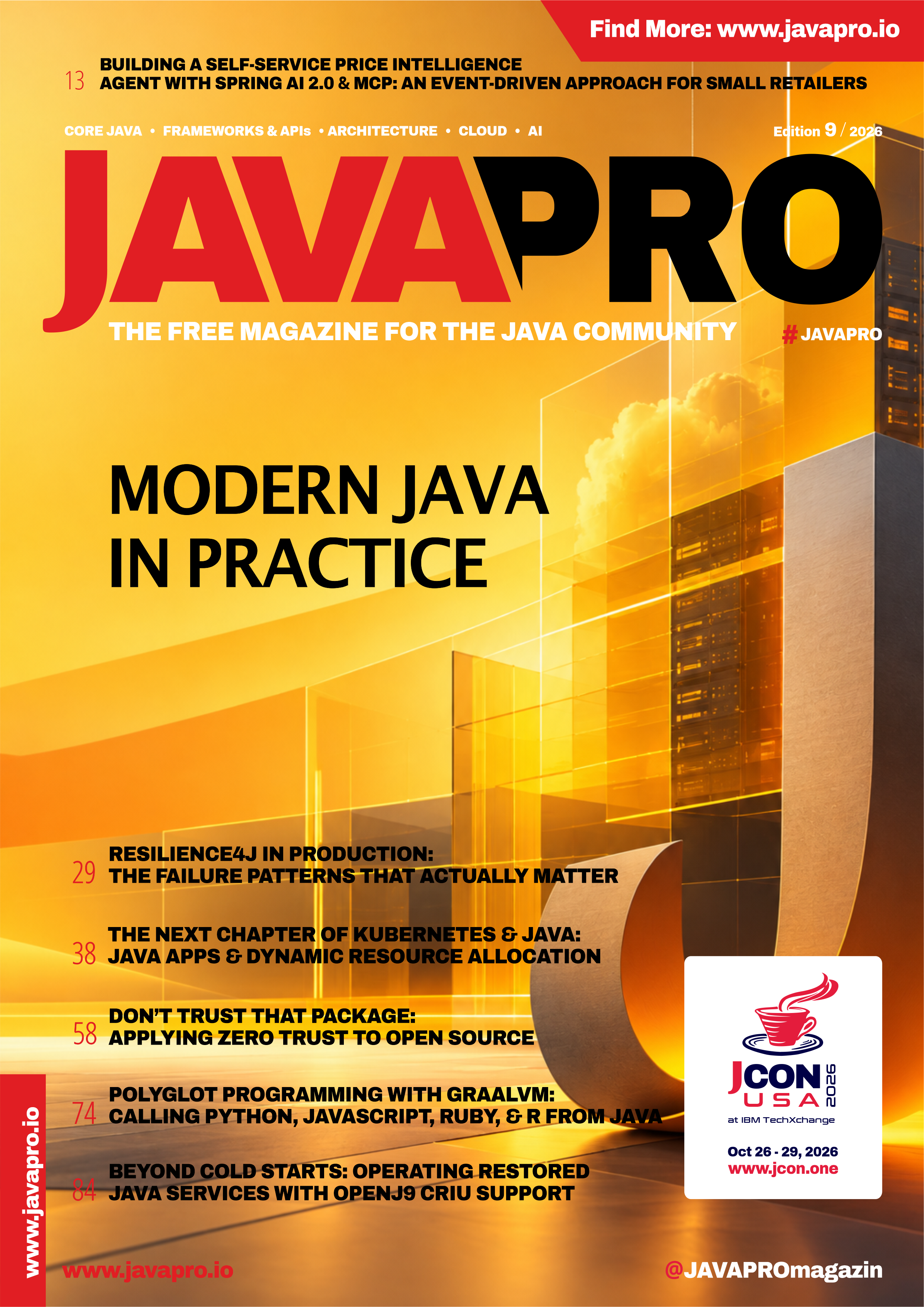
▪️Building a Self-Service Price Intelligence Agent with Spring AI 2.0 and MCP: An Event-Driven Approach for Small Retailers
ARCHITECTURE & MICROSERVICES
▪️ Reactive Programming Challenges in Java
▪️ Resilience4j in Production: The Failure Patterns That Actually Matter
CLOUD
▪️The Next Chapter of Kubernetes and Java: Java Apps and Dynamic Resource Allocation
WEB DEVELOPMENT
▪️The Server-Driven UI Renaissance
▪️ Joyful Web Development with Hypermedia-Driven Applications and HTMX
SECURITY
▪️Don’t Trust That Package: Applying Zero Trust to Open Source
▪️ Java 27’s Post-Quantum TLS Handshake: How JEP 527 Brings Hybrid Key Exchange to JSSE
JVM LANGUAGES
▪️Polyglot Programming with GraalVM: Calling Python, JavaScript, Ruby, and R from Java
PERFORMANCE
▪️Beyond Cold Starts: Operating Restored Java Services with OpenJ9 CRIU Support
Details
Page count: 90
Authors: Hyyan Abo Fakher, Tobi Ajila, Atiq Amjad, Yasin Baytürk, Catherine Edelveis, Richard Fichtner, Frederik Hahne, Soham Sengupta, Abdel Sghiouar, Babneet Singh, Suleman Yildirim
Editorial
Modern Java in Practice
Modern Java is not defined by a single language feature, framework, or architectural trend. Its real strength becomes visible when technology meets reality: when applications have to scale, recover, remain observable, integrate with other ecosystems, and stay secure under constantly changing conditions. That is what this issue is about.
The articles in this edition look beyond what modern Java can do and focus on how it actually works in practice. That distinction matters. A technology may look convincing in documentation or in a proof of concept, but production environments introduce their own rules. Resources change, dependencies fail, execution moves across threads, security assumptions become outdated, and architectural choices that once seemed obvious deserve to be questioned again.
Several contributions explore exactly these operational realities. Restoring warmed Java applications with OpenJ9 and CRIU, for example, can dramatically change startup behavior, but operating a restored JVM also introduces new questions around diagnostics, tuning, and reliability. Kubernetes is evolving as well, opening the door to more dynamic resource allocation for Java applications instead of treating CPU and memory as purely static boundaries.
Resilience and observability reveal another side of the same challenge. Patterns such as retries, circuit breakers, and bulkheads are easy to name but much harder to apply correctly when real failures occur. Reactive applications create similar surprises: a trace ID that appears reliable in a traditional request model can suddenly disappear when execution crosses asynchronous and reactive boundaries.
Modern Java development also means reconsidering established assumptions. Do we really need a single-page application for every modern web interface? Server-driven approaches and hypermedia show that rich user experiences do not automatically require another layer of complexity. GraalVM takes the idea of choosing the appropriate tool even further, allowing Java applications to work directly with Python, JavaScript, Ruby, and R when another language is better suited to a particular task.
And modern systems cannot be discussed without security. Post-quantum cryptography is beginning to influence the foundations of secure communication, while software supply chains require us to reconsider what it means to trust a dependency. A familiar package name, a popular repository, or a clean vulnerability scan is no longer sufficient evidence on its own. Trust increasingly has to be verified and continuously reassessed.
In the end, modern Java is not defined by what is possible in theory, but by what works in practice.
We hope this issue gives you new ideas, practical insights, and a few good reasons to reconsider how you build and operate your own Java systems.
My very special thanks go to all of the fantastic authors of this issue.
Enjoy this edition of JAVAPRO.


